You Don’t Need to Be the Expert to Own a Franchise

December 30, 2025

Why Leadership Beats Technical Skill in Franchise Ownership

One of the most common concerns I hear from people exploring franchise ownership sounds like this:

“I like the idea of owning a franchise… but I don’t know plumbing, fencing, or senior care.”

It’s a fair concern — and a very common one.

But here’s the reality:

You don’t need to be an expert in the core service to own a successful franchise.

In fact, many of the most successful franchise owners have never performed the service their business provides.


The Biggest Franchise Myth: “I Have to Do the Work”

Many people assume franchise ownership means:

  • You’re the plumber
  • You’re installing the fence
  • You’re providing hands-on senior care

That’s rarely the case.

In most franchise systems, the model is intentionally designed so the owner leads the business — not the toolbox.

Here’s how it typically works:

• ✅ The franchisor teaches the core service

Through structured training, manuals, systems, and ongoing support.

• ✅ Your GM or technicians deliver the work

Skilled employees or subcontractors handle day-to-day operations.

• ✅ The franchisor helps you recruit

From plumbers and fence installers to caregivers and general managers.

• ✅ You focus on growth and leadership

Sales, marketing, hiring, culture, and scaling the business.


What Franchisors Actually Look For

If you’re worried about not having technical experience, here’s some good news:

That’s not what franchisors care about most.

What does matter?

Transferable Business Skills

Franchisors love candidates with experience in:

  • Sales and business development
  • Managing and motivating teams
  • Leadership and decision-making
  • Following systems and processes

Personal Traits That Can’t Be Taught

Just as important are traits like:

  • Determination
  • Perseverance
  • Grit (especially when things get uncomfortable)
  • Coachability 👀

You can teach someone how to install a fence.

You can’t easily teach someone to lead, adapt, and stay committed when challenges arise.


Owner vs. Operator: A Critical Mindset Shift

Successful franchise ownership isn’t about doing the work.

It’s about building the engine that gets the work done.

That engine includes:

  • The right people
  • The right systems
  • The right culture
  • Consistent execution

When owners stay focused on leadership instead of tasks, the business becomes scalable, valuable, and often far more flexible.


Final Thought

If you can:

  • Lead people
  • Follow a proven system
  • Stay committed through the learning curve

Then the what of the business can be learned — or delegated.

Franchise ownership isn’t about being the expert.

It’s about being the leader.

If you’re curious which franchise models are designed specifically for this type of owner, that’s a great conversation to have.
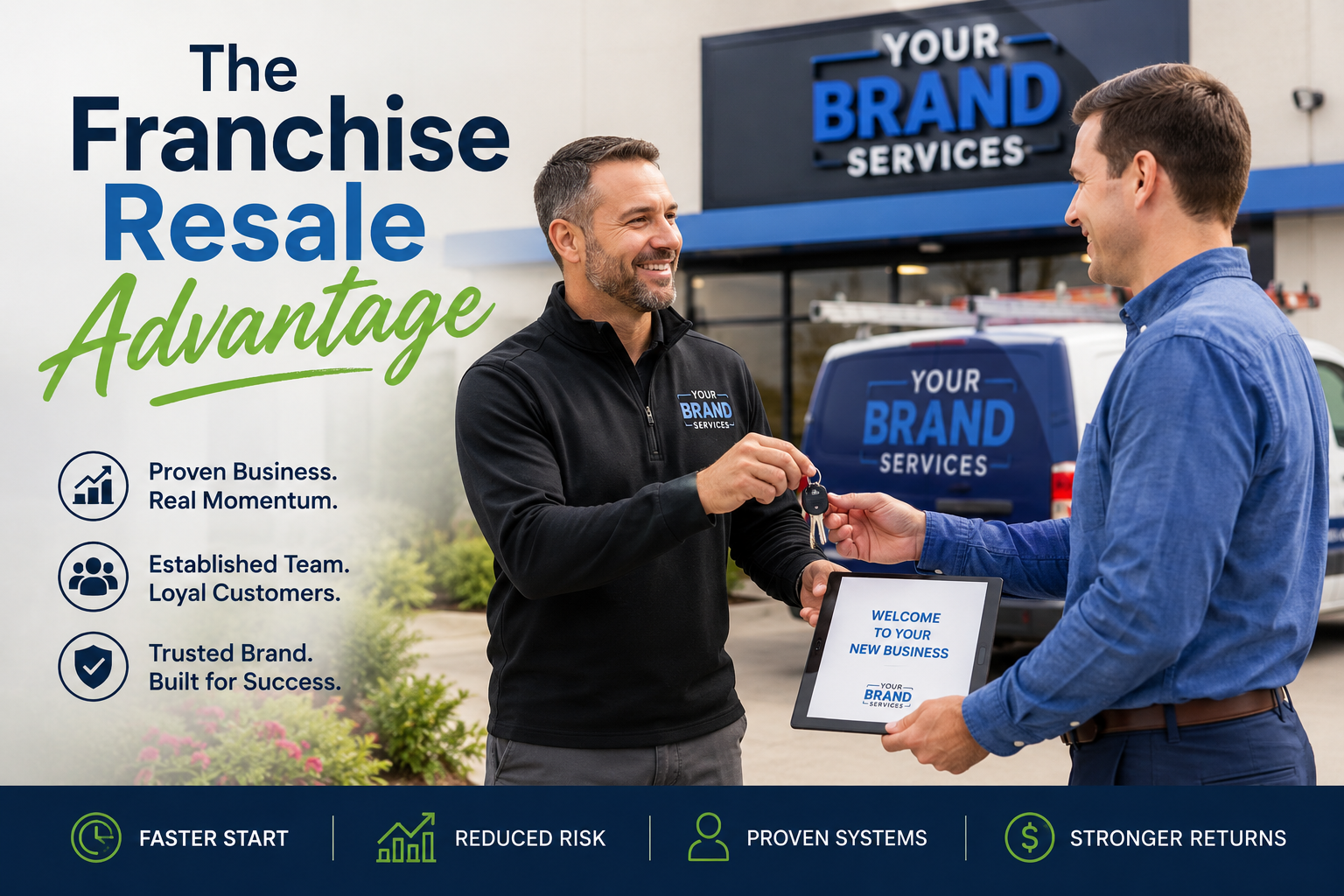
Two men shake hands beside a sign reading “he Franchise Resale Advantage and Your Brand Services.
June 2, 2026
The Traditional View of Business Ownership When most people think about business ownership, they picture building something from the ground up. They imagine creating their own systems, finding customers, hiring staff, and slowly growing the business over time. While that path can absolutely work, there’s another option that often gets overlooked — buying an existing franchise business. In today’s environment, where time, efficiency, and reducing risk matter more than ever, franchise resales have become increasingly attractive for entrepreneurs looking to enter business ownership or expand an existing portfolio. Instead of starting from zero, buyers step into a business that already has momentum. That can create a significant advantage. Why Franchise Resales Are Growing in Popularity One of the biggest misconceptions about franchise resales is the assumption that something must be wrong with the business if it’s being sold. In reality, that’s often not the case. Many franchise owners sell for personal or lifestyle reasons such as: Retirement Relocation Partnership changes Pursuing another opportunity Another common myth is that buying an existing franchise requires dramatically more capital than opening a new location. In many cases, financing options are very similar. SBA financing in the United States, for example, can often fund both the acquisition and working capital requirements with relatively low down payments, making resales surprisingly accessible. The Biggest Advantage: Momentum From Day One The biggest advantage of a resale is simple: momentum. When starting a business from scratch, the early stages are usually the hardest. Owners spend months building brand awareness, developing operational systems, hiring staff, and generating their first customers. A resale allows buyers to bypass much of that startup phase. Instead, they may acquire a business that already includes: An established customer base Existing revenue and cash flow Trained employees and management systems Brand recognition within the local market Operational processes already in place That head start can dramatically shorten the ramp-up period and allow owners to focus on growth instead of simply surviving the startup stage. For experienced operators, franchise resales can also become a strategic growth tool. More multi-unit franchisees are using acquisitions to expand into adjacent territories or strengthen their existing footprint. Rather than building each new location from the ground up, they acquire businesses that are already operational and integrate them into their systems to create efficiencies and accelerate growth. Faster Entry Compared to Buying an Independent Business Another factor driving interest in franchise resales is speed. Many entrepreneurs initially explore buying an independent business through business brokers or online marketplaces. What surprises many buyers is how long that process can take. Finding the right business, negotiating terms, completing due diligence, arranging financing, and finalizing legal agreements can often take: ⏳ 6–12 months or longer Franchise resales are often more streamlined because the franchisor already has established systems, operational standards, onboarding processes, and financing familiarity in place. Compared to launching a completely independent business, entrepreneurs can often move much faster while also reducing uncertainty. The Employee and Customer Retention Factor Another overlooked benefit of a resale is the transition process itself. In many franchise resale transactions, the previous owner stays involved for a period after closing to help the new owner learn the business, understand team dynamics, and maintain customer relationships. This type of knowledge transfer can significantly reduce the learning curve and create continuity for both employees and customers. That continuity matters. One of the biggest risks in buying any existing business is uncertainty around employees and customer loyalty after the sale. Staff may become nervous about leadership changes. Key employees may leave. Customers may question whether service levels will remain consistent. Franchise systems often help reduce this uncertainty because operational processes, branding, and support structures remain intact during the ownership transition. Employees and customers still recognize the brand, the systems remain familiar, and the franchisor often provides onboarding and transition support to help stabilize the business. The Critical Role of the Franchisor A strong franchisor can play a major role in making a resale successful. Many franchise systems provide structured guidance throughout the process, including: Business valuation guidance Marketing of resale opportunities Candidate screening and qualification Transition planning and onboarding support Operational training and coaching For many buyers and sellers, purchasing or exiting a business is something they may only do once or twice in their lifetime. Having experienced support throughout the process can make a meaningful difference. Of course, buyers should still perform proper due diligence before acquiring any business. Financial performance, employee retention, customer reputation, market positioning, and future growth opportunities should all be carefully evaluated. Final Thoughts At its core, franchising is about reducing uncertainty through proven systems and operational support. A resale builds on that advantage by adding existing customers, infrastructure, and cash flow into the equation. That’s why franchise resales are becoming increasingly attractive in today’s market. They offer entrepreneurs the opportunity to move faster, reduce startup friction, and focus more energy on growing the business rather than building from zero. For some owners, starting fresh will still be the right choice. But for others, buying an existing franchise may provide the ideal combination of momentum, structure, and long-term opportunity. Sometimes the smartest way to build something great… is to start with something that’s already working. 
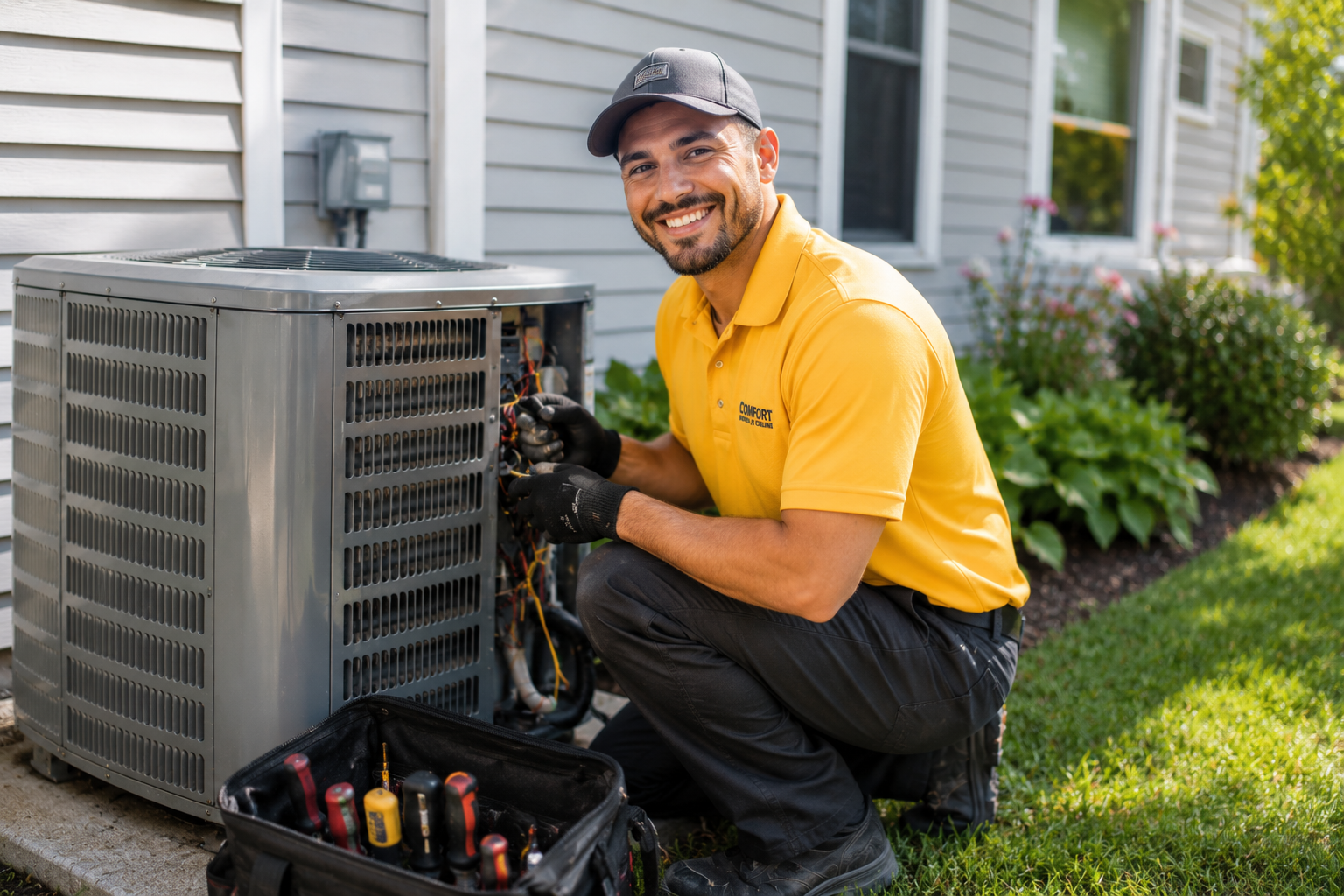
Technician kneeling beside an outdoor HVAC unit, smiling while servicing it with tools nearby.
May 28, 2026
The home services industry is growing in 2026 as homeowners prioritize comfort and energy efficiency. HVAC services are vital year-round and are considered a necessity for many households. Whether you’re an entrepreneur exploring HVAC franchises for new investors or evaluating HVAC businesses for sale, franchising offers a structured path into the heating and cooling service industry, with built-in systems, operational guidance, and brand recognition that help investors get started more confidently.  Understanding how HVAC franchises work can help potential owners determine if this opportunity meets their goals.
May 2, 2026
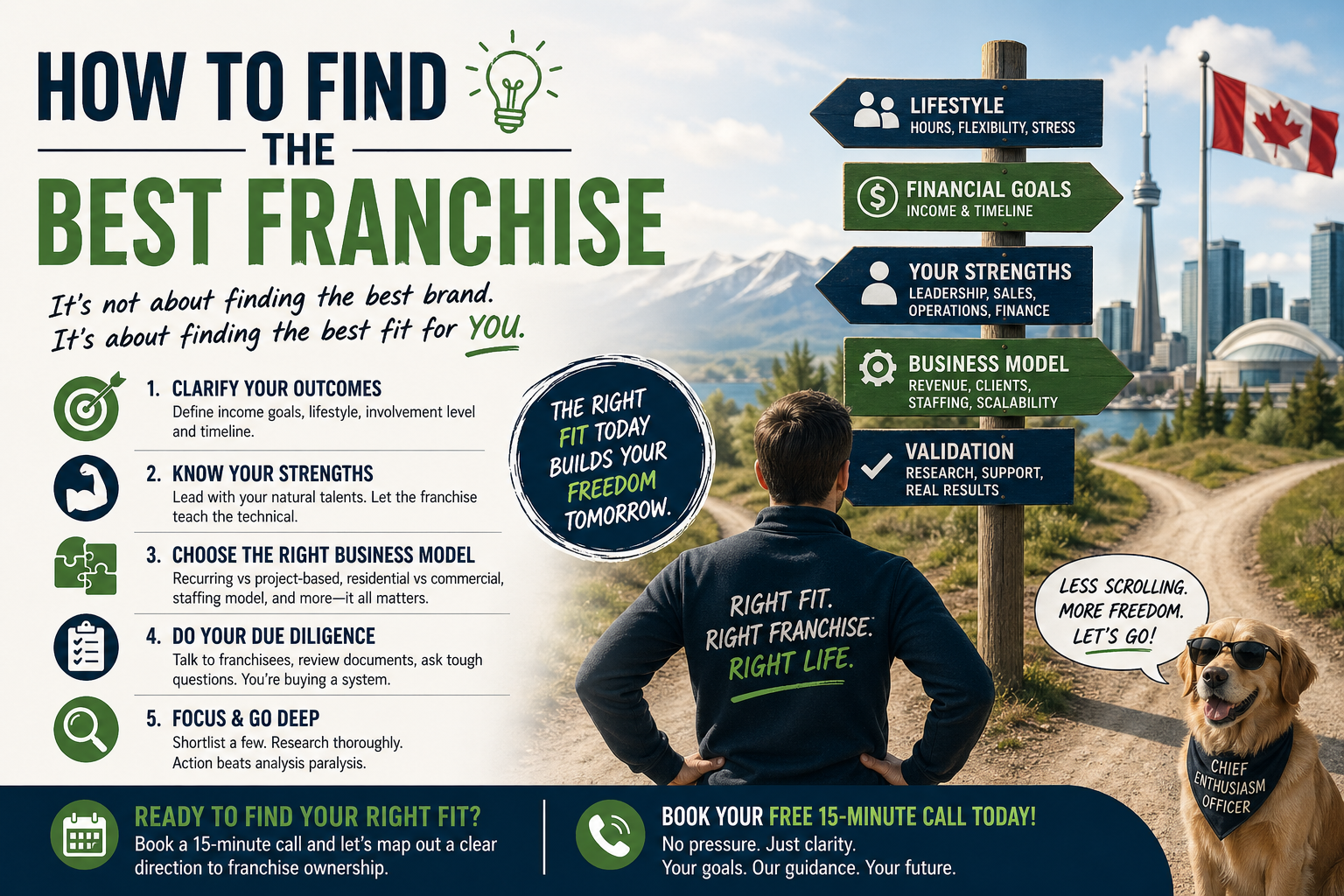
When most people start researching business ownership in Canada they Google “ best franchises to buy ,” and quickly get lost in lists, rankings and sponsored recommendations. The reality is there’s no universal winner — the important question is how to choose a franchise that fits your life and goals. After working with hundreds of professionals exploring franchising, I’ve learned the biggest mistake isn’t picking a bad brand, it’s choosing the wrong fit. Begin by clarifying outcomes before you look at brands. Define income expectations, desired lifestyle ( hours, flexibility, stress tolerance ), level of involvement ( owner-operator vs semi-absentee ), and the timeline to replace your current income. This focus on how to choose a franchise based on outcomes prevents you from chasing glossy logos instead of practical results. Someone aiming for 10–15 hours a week long-term should not be evaluating the same opportunities as someone who wants to build a large, hands-on operation. Be honest about your strengths. You don’t need to be an expert in the service, but you must know whether your talents lie in sales and business development, leadership and team building, operations and systems, or financial discipline. Franchisors will teach technical skills, but your role in choosing a franchise is to match the business model to what you can lead and grow. Understanding this distinction is a core principle of how to choose a franchise that will scale under your management. Choose the right business model carefully. Not all franchise concepts are built the same: recurring vs project-based revenue, residential vs commercial clients, employee vs subcontractor staffing, and high-ticket vs high-volume services all matter. For example, a painting franchise ( project-based, subcontractor model ) is fundamentally different from a pest control or cleaning franchise with recurring route revenue. When choosing a franchise, these structural differences determine income predictability, day-to-day workload, and scalability. Conduct thorough validation. Speak with multiple franchisees, understand realistic ramp-up timelines, review disclosure documents and financials, and ask detailed questions about marketing, lead generation and corporate support. You’re not just buying a brand — you’re buying a system — so the due diligence step is essential for choosing a franchise that delivers the support and ROI you expect. Avoid analysis paralysis by narrowing your focus. Too much breadth in research leads to inaction. Shortlist a few strong candidates and go deep on those — interview franchisees, visit operations, and test assumptions. This focused approach is the simplest way of how to choose a franchise without wasting months or years on endless comparisons. Choosing a franchise successfully comes down to alignment: your goals, your strengths, and the business model. That alignment—not a top-ranked list—is what produces consistent results. If you want help cutting through the noise and focusing on opportunities that actually fit, I help Canadian professionals fast-track the process. Book a 15-minute call and we’ll start with your goals and map out a clear direction for choosing a franchise that’s right for you.
Top Drivers for Investing in a Franchise
January 6, 2026
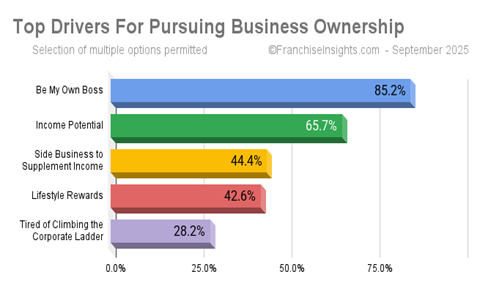
Insights from a Nationwide Franchise Investor Survey Every year, an independent marketing and lead-generation organization within the franchise industry conducts a large annual survey to understand what truly motivates people to explore business ownership. The most recent results, published in October 2025 , offer a clear and compelling picture of today’s aspiring entrepreneurs — and confirm what I hear every week in conversations with professionals considering what’s next. Despite differences in age, background, and career stage, one theme consistently rises to the top: people want more control over their future. Who Is Exploring Franchise Ownership Today? With Baby Boomers retiring in record numbers and Gen-X and Millennials now representing the largest share of franchise investors, business ownership is no longer limited to one generation or life stage. What unites them? A shared desire to: Reduce dependency on employers Gain more autonomy Build something they truly own In short: control their own destiny. The Top Motivations for Business Ownership Survey participants were asked: “Why do you want to own your own business?” (Multiple answers were allowed.) Here’s how the responses ranked — and what they tell us. 1. Be My Own Boss (85.2%) This remains the c lear and dominant motivator — and has for years. Not income. Not flexibility. Not even lifestyle. The strongest driver is autonomy. People want: Control over decisions Freedom from corporate politics Ownership over their time and direction More than anything, they want to stop feeling like their future is dictated by someone else’s priorities. 2. Income Potential (65.7%) Income remains a strong second — particularly in a time marked by: Layoffs and restructurings Salary caps Rising cost of living However, it’s telling that financial upside ranks behind independence. For many, income potential is about security as much as growth. 3. Side Business to Supplement Income (44.4%) For the first time , this motivation moved into third place — overtaking lifestyle rewards. This shift suggests growing interest in: Semi-absentee or part-time ownership Shared ownership models Lower-risk entry points into entrepreneurship Retaining an existing income stream while building equity In uncertain economic times, many people prefer a measured, strategic path into ownership rather than an all-or-nothing leap. 4. Lifestyle Rewards (42.6%) While still important, this motivation dropped from 47.1% in late 2024. Lifestyle rewards typically include: Working from home Flexible schedules Seasonal or locally focused businesses The pandemic proved that flexibility can work — even as many employers have enforced “back to office” mandates. As a result, work-life balance remains a priority, just no longer the primary driver. 5. Tired of Climbing the Corporate Ladder (28.2%) Nearly one-third of respondents cited fatigue with corporate life. This reinforces something I see consistently: many aspiring business owners bring significant professional experience , leadership skills, and maturity — they’re not running from work, they’re moving toward something more fulfilling. What These Results Really Tell Us Most people exploring business ownership today are not chasing a fantasy. They are looking for: Greater control Stability and optionality A smarter long-term strategy A business that fits their life — not the other way around That’s why the right business matters far more than any business. Where Guidance Matters Most With thousands of franchise and business options available, the challenge isn’t access — it’s clarity. Understanding: Why you want ownership What role you want the business to play in your life How much risk you’re comfortable taking What structure fits your current reality These answers shape everything that follows. My role as a consultant is to help people cut through the noise, align opportunity with intention, and determine whether business ownership makes sense — and if so, what kind of ownership actually fits. Final Thought If any of the motivations above resonate with you, you’re not alone — and you’re asking the right questions at the right time. The goal isn’t just to own a business. It’s to own the right one , for the right reasons.
October 31, 2025
A Practical Guide for Anyone Exploring Business Opportunities in Canada
September 2, 2025
Why Building a Franchise in Canada Can Be Your Ticket to Tax-Free Wealth
August 6, 2025
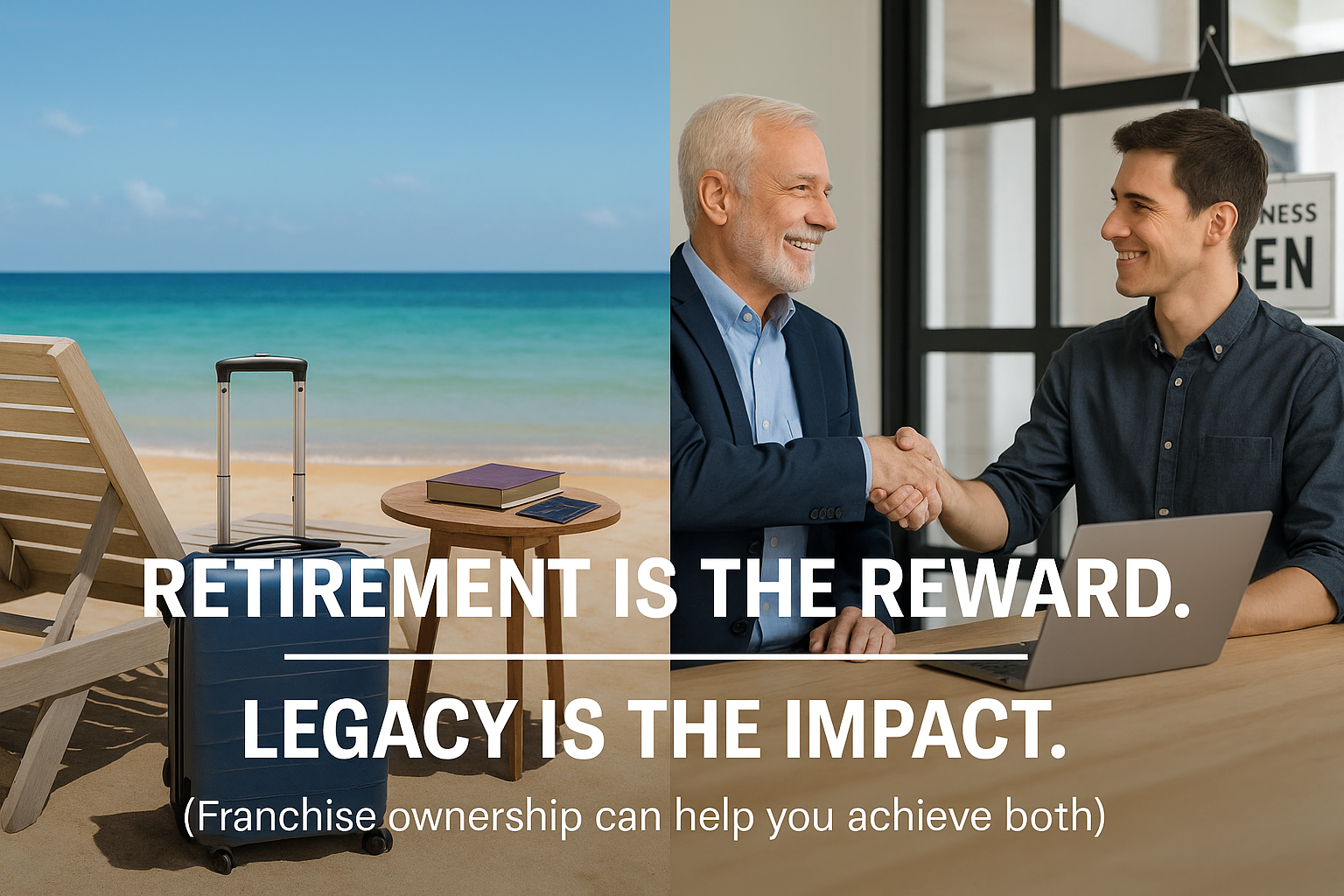
Retirement is the Reward Legacy is the Impact
July 31, 2025
The Top Professions that Excel in Franchise Ownership and Why !